Wednesday, August 31, 2011

Week 8


In the eighth week, my adviser asked me to stay at OIMB for one extra week, in order to polish up the website. I happily agreed, so I'll be here for a total of nine weeks. The website definitely needs a good deal of work so I am happy to put in more hours on it. Though to be honest, photo processing is exhausting work!

Most of this week was spent preparing for final presentations, which took place on Friday. I spent most of Tuesday reviewing notes on good ways to structure presentations. I gave a few practice presentations to my friends and felt ready to present on Friday. The presentations took place in a classroom at the Oregon Institute of Marine Biology. Unfortunately the Hatfield Marine Science Center interns did not come down to Charleston for the day, but we did get the chance to see their presentations via Skype.

During my presentation, I spoke briefly about my future plans for the website (akiko-invertebrates.weebly.com), which I made to house the identification key which is my summer project. With my extra time at OIMB, I hope to label the basic anatomy of the juvenile settlers, and post a few photos of what each settler looks like as an adult colony. The website needs a lot of editing, and I have received many helpful comments about how to improve it. I hope that I have enough time to apply them all!


This is me looking through the dissecting microscope, which I used for the bulk of my work. Every day, for four weeks or so, I looked through this microscope to take pictures of the settling organisms.


A friend of mine took this photo of me and some ascidians. The large orange blobs are Distaplia occidentalis colonies, growing on a piece of netting that has been submerged for several months.

Wednesday, August 17, 2011

Week 6

The weeks have flown by! I have been hard at work. During the sixth week, I finally stopped taking daily photos of the settlers. It's fun to do work under the microscope, but hard when you're doing it every day! I compiled all of the photos I took (over 2,000!) and began sorting through them in order to find the highest quality ones for each species. Once I had chosen the nicest photographs, I began the long process of modifying them with Adobe Photoshop. Since I am new to both microscopy and photography, most of the pictures that I took were blurry, too dark, too bright or off-colored. Additionally, many of the organisms that I photographed are translucent, making them even harder to see on a picture. With Adobe Photoshop, I can adjust the photo to make the image clearer and more representative of the actual organism.

In addition to image quality modifications, I can also use Photoshop to create composites of multiple images. This is a very useful way to deal with the limitations of microscopy. With microscopes, the focal plane-- that is, how much of the object is in focus-- is very thin. This means that at any one time, only some parts of the 3D organism will be in focus. In any one picture, only a portion of the organism will be in focus and the rest of the organism will be blurry, as shown below. However, with Photoshop, I can slice out the parts from each picture that are in focus, and combine them together to make a composite image in which most of the organism appears to be in focus.

Here, the base of the organism is in focus.


Here, the top part of the organism is in focus.


This picture is a composite that I have made using Photoshop, by combining the two above images.


Photo processing takes a good deal of time to do, and I spent many hours going through the photos in order to get them cleaned up and presentable. In addition to that, I also began to learn how to make a website on using the "Weebly" website creation page. Thankfully, the interface on the Weebly page is very user-friendly. I am still ironing out the finer points of the web page but so far it is looking good! It is still under construction, but is viewable at: akiko-invertebrates.weebly.com .

Monday, August 8, 2011

Week 5

In the fifth week of the internship, all of the OIMB interns in Charleston and the Hatfield Marine Science Center interns from Newport got the chance to come together and show off our projects. The COSEE PRIME program makes a huge effort to support communication and collaboration among scientists, which is such a great initiative. Having spent many hours in the lab, I can see how a researcher could become so involved in their work that they don't get the chance to see what other scientists are doing in similar fields. However, collaboration is so important, because the results that you get under a microscope could heavily influence the work of another researcher doing a similar project.

On Wednesday, Coty and Drew came down to Charleston with their adviser Itchung. I showed them all my project and let them watch the little ascidians pump water into themselves. Every once in a while, the organisms will contract their branchial baskets and close their siphons as if they are coughing or exhaling. From what I've read, this is to keep large particles from entering their incurrent siphons. This reaction is touch-sensitive, so sometimes I will tickle the ascidian with a single hair (that's how small and sensitive they are) and watch them contract. Later on that afternoon, we all went out with Professor Jan Hodder to see some marine mammal action at Cape Arago. Seals and sea lions sunbathed on the rocks, and a few gray whales broke the surface every few minutes.

On Thursday, Karyn, Jess, and I with our adviser, Coral, went up to Newport to visit with the interns there and see their projects. This was the first day in over 3 weeks that I took a full day off and didn't look at my petri dishes! It was nice to have a little break and it gave me time to reflect on my project progression and to write in my research notebook. We got to stomp around in the mud with Drew, and visit Coty's bird-watching location. It was a nice trip, but good to come back home!

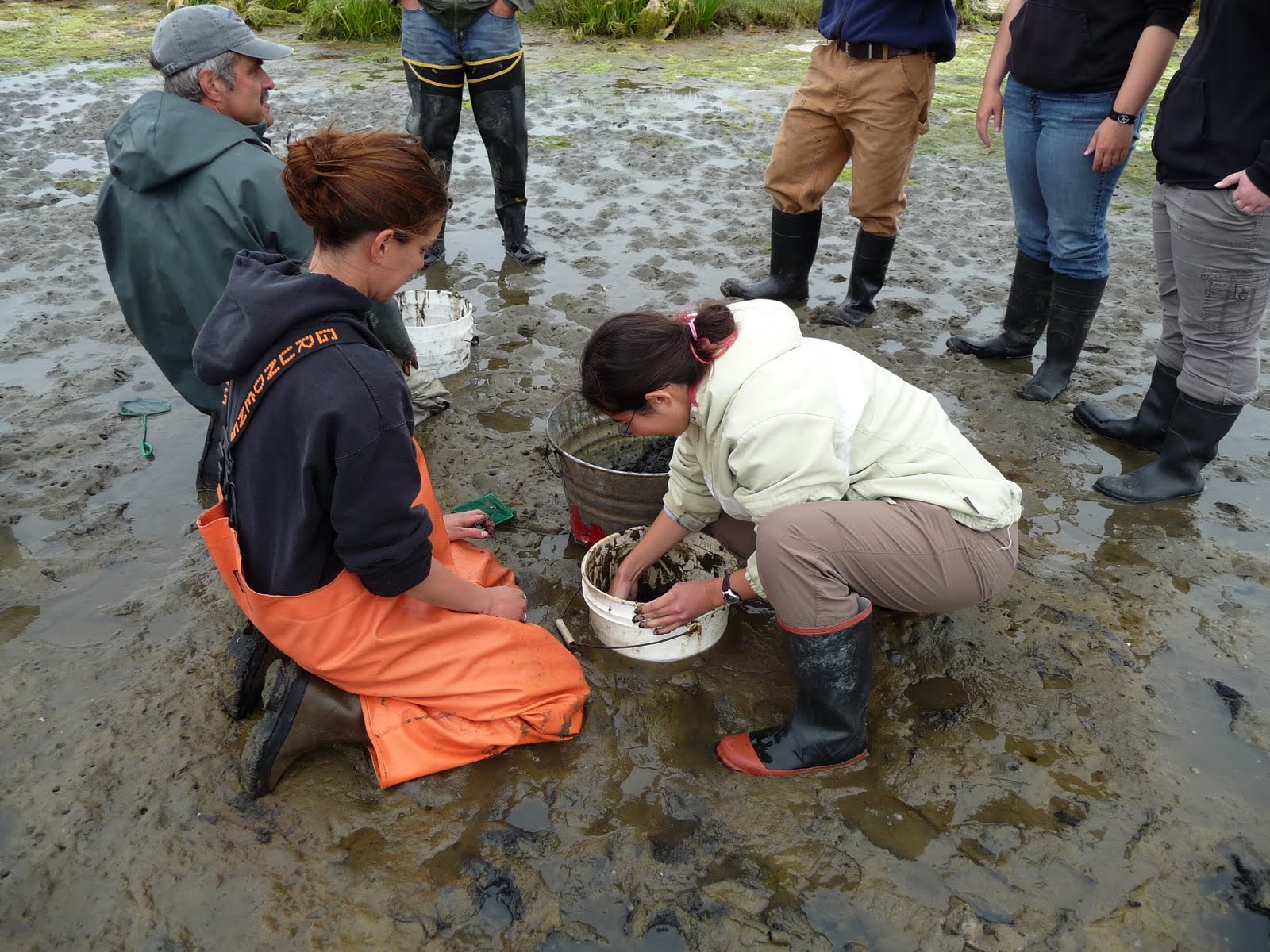
Playing around in the mud was fun. I got to use a huge siphon to suck shrimp out of the mud. We saw ghost shrimp and mud shrimp.


We had a blast looking at marine mammals at Cape Arago!

Wednesday, July 27, 2011

Week Four

Hey All, Akiko here.

My goodness the weeks are passing by so quickly! During the fourth week, I watched my six new plates get colonized by a variety of settlers. The plates are fouling quickly, which is good because it means that a lot of organisms are settling down on it, but is also difficult because algae and particles have clouded the petri dish and make it hard to clearly see the organism in photos.
I decided to make a little side-experiment out of the redeployment. I actually deployed 12 plates with velcro on the sides instead of underneath. Of the 12 plates, six of them have abrasion on the top side (I scrubbed them with sandpaper to make the surface rough) while six of them are simply smooth plastic. I did this because supposedly settlers prefer to settle on roughened surfaces, and I figured that I could keep track of the rate of settlement on the clear plates versus the smooth plates. I'll count the number of settlers on each plates at some future time during the experiment and see whether the settlers really prefer rough over smooth.

For my main experiment, every day is the same procedure: get the petri dishes out of the water, look at each of them under the dissecting microscope, take photos of specific organisms, and keep track of new species that arrive on my plate. It sounds easy, but the entire process takes about 3-4 hours, and I do it every day (even the weekends). I am trying hard to be a good scientist, even if it means sacrificing my days off. On the bright side, once I start looking at the plates I'm often so absorbed in observing the changes that go on from day to day that the time goes by faster than it would otherwise.

Here are some of the new organisms that have collected on my plates. I haven't had time to adjust the images or put in scale bars, but suffice to say that they are really tiny!

This is probably Schizoporella japonica, a bryozoan. Bryozoans are little animals that settle onto surfaces and reproduce asexually to form larger colonies. This kind of bryozoan is an encrusting bryozoan, meaning that it will continue to spread over the surface in a hard thin layer, like dried paint. When this bryozoan gets bigger, it will begin to reproduce assexually to form a colony.


The spiral shell in this photo belongs to what I believe is a serpulid polychaete worm. You can see little feeding structures sticking out of the mouth of the shell. That is the worm. With these guys, I have to wait for them to peek out of their shells before photographing them.

Friday, July 15, 2011

Trial and Error

((these posts are taken straight from the blog that I have to write for my internship, so they're not quite as personal))

In the third week of my internship, I spent a lot of time focused on my research project. I spent a lot of time diligently following, photographing, and observing the little ascidians that settled on my plate. I used velcro on the backs of my petri dishes to attach them to a large plate hanging in the bay. However, this velcro created a problem in that it obscured the light from the microscopes when trying to take pictures of the ascidians. Furthermore, I found that my original intention of setting out 20 petri dishes was too ambitious: I quickly found myself inundated with work trying to photograph 20+ organisms each day!

I decided that I needed to rethink and redo some parts of my project. With the guidance of my adviser, Professor Richard Emlet, I made new petri dishes that had velcro on the sides of the plates rather than underneath them. That way, the velcro wouldn't distort the light. I also decided to downsize the number of petri dishes deployed. Now I have six clear petri dishes to keep track of instead of twenty. I also decided not to take pictures of all of the organisms each day, but to rotate through them.

On the up side, I am learning something new every day. Each day I dedicate a lot of time (around 3 hours) to observing and photographing the tiny organisms under the microscope, and then I put in a few hours to tidying up the images with photoshop. I'm learning how to recognize settlers of different species too! Here are some that are easy to identify.


Do you recognize this one? This is Botrylloides violaceus, the pictures that I posted on my last blog entry. They are generally easy to recognize because of their huge sunburst-like ampullae and their red, orange or purple hue. They are also relatively large compared to the other early settlers that I see under the microscope.


These next two images are of a different species of colonial ascidian. This is called Distaplia occidentalis. In these photos, you can see three or four little ampullae that look like legs of a tripod in contact with the surface of the petri dish. You can also see a large cylindrical shaped structure that looks like a mesh tube. That is called the branchial basket, and it's connected to the organism's
incurrent or branchial siphon- the nozzle that sucks water into the organism.


Yet another organism that fouls my plates: the sponge. Unfortunately, I don't know the scientific name of this one. However, I do get a lot of sponges on my plates and I take pictures of them, even though they aren't as charismatic as the colonial ascidians.

Wednesday, July 6, 2011

Project update

So I spent most of the first week researching and designing my project, and during the second week I got to finally start implementing it. After a lot of planning I figured out a way to catch some pictures of microscopic settlers as they mature.

First I sanded the surface of a few petri dishes in order to make an abrasive surface. Supposedly, invertebrate settlers find the roughened surface more appealing to attach to. Then I attached velcro strips to the back of each petri dish with glue. I put longer strips of velcro on a large rectangular plate. This large rectangular plate has four holes drilled into it and rope tied to it, such that it can hang from a dock and be suspended in the water column. After lots of preparation, I attached my petri dishes to the backing plate and lowered them into the water for a few days, checking them every day.

I kept track of individual organisms by making a small grid that can fit over each petri dish, so that I can track their location and confirm that it's the same organism. It's very hard to keep track of them when they are so small! Every day, I took a photograph of each invertebrate settler. I have found that it is difficult to get good images when you're taking a picture through a microscope, but with some lighting adjustments and photoshop help, I hope to get images that could be used for identification.


These images are all of the same organism. I'm pretty sure that the scientific name is Botrylloides violaceus. I have had quite a number of these settle on my petri dishes. They are easy to identify because of their ampullae: the sunburst-like ring around them.

Saturday, July 2, 2011

Beach Day- Oregon Coast style

I spent my Saturday hanging out with the other OIMB kids at the beach! A bunch of us crammed into a car and drove over. This beach is different from the beaches at home. I'm used to Manele/Hulopo'e bay: where the waves break one by one on the sand and the ocean floor drops off to 6 feet or so and then gets deeper from there. Here, the sand slopes down into the water very gradually, such that you can walk out away from shore for at least 20 yards and still be able to stand. However, there are constant waves breaking over you and wicked cross current. Not to mention, the water is around fifty degrees Fahrenheit! For those of you who have never experienced water like that, it means that as soon as you walk in the first sensation you feel is cold, and the second is a flood of pain. It takes about ten minutes for each part of your body to slowly become numb, but until it does, it is pretty excruciating. Last week, I was proud of myself for staying in the water for around 35 minutes without a wet suit. This week however, there was a spare wetsuit so I put it on and went swimming with a few other students. It was fun to be in the water again, though the white wash was battering my face and body with each wave. In fifty degree water it is physically painful to dunk your head in, so duck-diving under the waves was a little difficult.

After my swim, people played football and beach ultimate frisbee. I wanted to play ultimate badly, but I have a terrible blister on my foot that has refused to heal. Just walking on the sand was painful, so I sat out of the game and laid in the sun. Really, not too bad of an option in itself.

So far my experience here has been wonderful. The students are inclusive, accepting, fun-loving and enthusiastic. I'm so glad that they have all made it easy to have friends here. Hanging out with all of them really defines the experience as a positive one for me. The amount of joy and satisfaction in my life relies so heavily on attitudes of people around me, and I am very thankful for all of the positivity and support that I've gotten from the OIMB students.

Friday, July 1, 2011

Some Pictures

The two mushroom like blobs on the left are Distaplia occidentalis, colonial ascidians. The pink colored blob on the right is a sponge, Haliclona sp.


This is Didemnum vexillum the invasive species that has been spreading around the globe. It is also a colonial ascidian, meaning that this blob is made up of thousands of tiny individuals called zooids.


This is from my first day of collecting data! I took this picture of a Botrylloides settler who has just metamorphosed from a free swimming larva to a settled organism. The little sun burst like arms are called ampullae. The main "body" where most of the dark pigment is, is the first zooid (individual) to settle down and is called the oozooid. The oozooid then begins asexual reproduction by budding off new copies of itself, called blastozooids. You can see that this specimen is just starting to make blastozooids- they are the transparent blobs coming off of the top and bottom of the oozoid.

Thursday, June 30, 2011

Summer 2011 at OIMB

Yet another attempt at keeping an updated blog :)
I am at the Oregon Institute of Marine Biology, where I will be spending my summer. I am required to keep a blog, and the official blog is at http://coseeppprime.blogspot.com/ However, as that is the official blog, I'm going to repost them here on my blog and also embellish those posts with my own personal feelings as well.
Anyhow, here's my first post. Pictures will be added soon :)

My name is Akiko Onuma, and I am lucky enough to be one of the COSEE Pacific Partnership PRIME interns. About a week ago, I wrapped up my finals and projects at Portland Community College and moved out here to the Oregon Institute of Marine Biology in Charleston, Oregon. It’s my fourth day here and so far I’ve had a pretty awesome time!

On my first day of the program, I met with my mentor, Professor Richard Emlet, to get an idea of the purpose of my project. He told me about the many different invertebrates living in the two boat basins in Charleston. A few of them include colonial invertebrates, where hundreds of tiny individual organisms make up a larger colony. The organisms that I will be studying are called fouling species, meaning that they attach themselves to hard surfaces underwater. Most of them look like slime growing on rocks or boat hulls, which is how they got their name "fouling organisms". My project will be to make a photographic timeline/identification key that will look at a variety of these marine invertebrates from when they are very small to when they are much bigger. Most of these organisms go through a larval period, meaning that they start off as a microscopic swimmer floating through the water. Soon, they find a hard surface and settle down on it, undergoing metamorphoses in order to attach themselves to the substrate. Then, they start to “grow” by asexual reproduction, which basically means making more of yourself in order to start a colony. It is the colony that is visible to the naked eye, and identifiable. So my job is to take pictures of these species from the time when they first settle (attach themselves to the surface of my petri dishes) until they are big enough to be identified.

Harbors and marinas are often hotbeds for introduced and invasive species because boats will pick up and distribute these hitch-hiking species wherever they dock, much like the marks left by a child playing with a jar of glitter. One particularly important introduced species is called Didemnum vexillum. This colonial organism, which looks like pale orange slime growing on the rocks, is an invasive species. Scientists believe that this organism originally came from Japan, but it is showing up in docks all over the world. Didemnum has documented presence in Japan, New Zealand, France, Ireland, California, New Hampshire, and now recently has started settling in Oregon. Furthermore, once introduced, Diademnum grows rapidly and can cover large areas in a short period of time, out competing other native species for space and resources.

Tuesday, July 13, 2010

Motivation Juice!

This is to motivate me to live my life actively!

I believe that I can be an awesome person! However, that awesomeness gets bogged down from hours on gmail and facebook and stumbling around the internet.

I want to work in the ocean. I have always been a water person. The ocean is my home, it is my spirit, it calls to me.
How can I reach this ocean goal unless I work toward it? Though the drudgery of searching for scholarships, writing essays, meeting deadlines, and navigating websites may seem unending, remember: somewhere at the end of this search lies my chance! I must believe that there is a job out there that is ideal for me, that will make me happy. I must believe that there are people out there who love the ocean like I do, who would happily snorkel and free dive and romp like dolphins with me, who will be my pod, where I belong! I believe, I believe, I believe.

For now, I am far from the ocean, and the distance weakens my appetite for the water. I am happy here in Portland, and I believe that I am where I'm supposed to be right now- living with friends, figuring out who I am. But I must not let this opportunity pass me by. Ironically, this plethora of time dulls the edge of my motivation, and I am given to slothful activities. No more! Let me awaken to this day, to this life!

Monday, March 15, 2010

Daily Miracles

I'm in a really good, pensive mood and it's the right time to write a blog, though I might not get the chance to finish it right at this moment.

Right now, I am in Seattle staying with friends and playing a lot of Ultimate. Today, navigating home to a friends house on public transit, I felt overcome by appreciation at the multitude of small miracles that go oft unnoticed in daily life.

A simple bus ride triggered this feeling of awe and gratitude. My Lanai upbringing has not prepared me for bustling city streets, rapid public transit, tall buildings, crowded noises or urban route mapping. The Lanai girl in me watches in admiration and a bit of trepidation as I climb steadily aboard a behemoth bus, cling to the railing against the jolt of the starting engine, and *track* the passing streets scanning for my stop. Reminiscent of my conversation with my high school friend Amanda, I can't believe that I have come so far from my home and everything that I'm used to. And I admit, I am very proud of myself.

There are days when every detail in the world seems wonderful and amazing. White pink cherry blossoms fluttering in the wind. Magnolia tree flowers assertively trumpeting their light maroon hue. Simple sunlight, smiling down to caress my skin. There are days when all I can do is marvel at the fact that I am alive and privy to the beauty of the world around me, as if it were some grand secret--delightful when kept to myself, but all the more thrilling when shared with other people.

Traveling up the coast has really given me an appreciation for friends. In a magical and serendipitous way, love, kinship, and trust transform strangers into life, home, food, and heart-sharers. Friends banish the lonely desolation that would normally cloud my being. Comradery and solidarity are essential to my well-being.

Yet, I cannot help but wonder while in the company of more jaded friends whether my unbridled enthusiasm for life gets old and annoying. Sometimes it's the drift that I get from them, and I try to tone down my excitement. Is it because I'm still young enough to believe in the mysticism of the world around me?

Tuesday, March 2, 2010

West Coast adventures

I'm terrible at keeping updated at all on blogs... so here's what I've been up to for the past week (copy and pasted from a facebook note I made). To be fair, I suppose that if you lead an interesting life, there's no time to post things into a blog... is that justification?
------------------

Various people have asked that I keep them posted about my west coast adventures so here we are:
I woke up on Thursday, Feb 25th at around 9am after going to bed late the night before (sleep dep night 1), finished packing and said goodbye to everyone. Greg drove me down to the Metrolink station in Alan's car and I got on the train at 11:30am towards Union station in Los Angeles. I was a little sad to be leaving my college-home in Claremont and all of the loved ones that are still there, but it was high time for me to get my adventure underway. After about 2.5 hours of trains, subways and buses, I was dropped off a few blocks from UCLA campus. (total travel time = 2.5hrs) A woman on the bus was kind enough to show me how to get to the campus and emphasized that UCLA is a enormous campus. After a bit of walking (not as fun, with so much luggage) and a call or two, I met up with my Scripps friend Kate who showed me where to put my luggage in her fiance Ryan's laboratory. It was such a relief to put my bags down (this will be a theme). She pointed me in the direction of a cafe and I had a delicious bread bowl with vegetable soup, which I ate hungrily. (Turns out that half a pancake for breakfast does not satisfy you for 6 hours, silly me.) Then I met up with my home friend Amanda and we walked around UCLA for quite a few hours talking about Lanai. Both of us marveled over the fact that two Lanai girls had made it all the way out to the west coast and were now getting together in one of the biggest cities in the US... so far from our roots. Something that Amanda said stuck with me: "Sometimes I think about it and I can't believe the situation I'm in, I can't believe I'm here" (my paraphrase) and I've been thinking about that ever since. When I think back to the fact that I spent the first 17 years of my life on a small island in the middle of the pacific and managed to find the courage and motivation to move off, and furthermore that now I have the gall to plan a train trip up the west coast via public transportation despite the fact that we don't even have public buses on Lanai and the roar of trains and subways still makes me want to flinch back in fear.... well, I've come a long way. Anyhow, Amanda and I had a nice long chat and then I dropped her off at her bus stop and went back to Ryan's laboratory. Kate was going to take a while to finish so we took my luggage and hung out at her lab until she finished and then we all went to dinner at a delicious thai food place.
As we walked back to Kate and Ryan's apartment, I was surprised when Ryan asked what parts of LA I wanted to see tonight. Since both Kate and Ryan worked the next morning, I had been expecting to retire early and it was already going on 10pm. Instead, when we got back to the apartment, we dropped off my luggage (whew), had a brief playful encounter with Aiko, the more sociable kitty, and then headed off into the LA night. We stopped at a Japanese market and I was shocked to see all of the grocery items common in Japanese stores. It was like being back in Hokkaido all over again. What a bizarre feeling. I bought some treats for the train ride and then we got back in the car and drove all over LA. I was a little overwhelmed by the sights and after a while had to close my eyes in order to calm my brain down a bit. It had been an exciting day and my mind was still reeling from it all. We drove back to the apartment and watched a few youtube videos of various acapella groups before going to bed at a little before 2am. My bed was a huge inflatable queen size air mattress that came up to above my knees and was very comfy. We all woke up at around 8:30am and went for breakfast at a coffee shop.(sleep dep #2) I bid goodbye to Kate and Ryan and went for a short run around UCLA campus before returning to their apartment, packing hurriedly and walking with my ungainly luggage to the bus stop. I retraced my route to Union station and got there early to wait for my bus/train commute to Oakland. (total travel time= 3.5hrs) I got on the bus and had an uneventful Amtrak ride to Bakersfield, CA where I switched over to the Amtrak train going to Oakland. The train ride up to Oakland was fine, and I studied a bunch for the GRE test and even took part of a practice GRE on my computer. I even ate a surprisingly delicious bean and cheese burrito. No sleeping for this weary traveler though. I'm not good at sleeping on trains.
I got to Oakland at 10:15pm (total travel time=11.5hrs) and was picked up by Shy. We drove back to the Co-op where he lives, which is a cool two story house shared by 6 or so environmentally conscious free-gans. We stayed up and talked until about 1:30am because I had trouble falling asleep after an entire day spent in the train. I woke up the next day at around 10:00am and helped Shy clean windows after breakfast. It felt good to give something back to the person who was housing me, and in the future I will have to remember to help out with little chores where possible when staying with friends. Then, Shy left to go to an Ultimate tournament and I headed off to Berkeley. I visited with Vivian there for a large bulk of the day and we took a long walk around Berkeley's campus. I had called another friend, Autumn, to see if I could stay with her overnight and she agreed but then had trouble reaching her for a large part of the day, so I spent a lot of energy worrying about whether I would be able to find a place to sleep for the night. Fortunately, at around 8pm, I finally got in contact with her and at around 10:15pm she picked me up and drove me to the house she shares with 3 other Claremont alums. I slept deeply and contentedly from around midnight to 7:15 (sleep dep #3), when Autumn needed to go to a tournament. I ate the best breakfast I've had this entire trip (Yogurt with Granola, Orange Juice and Good Earth tea!! I approve!) before bidding Autumn and her boyfriend goodbye and hopping on the Bart to take me back to Oakland. I got back to the Co-op without any incidences (yay for being able to navigate and follow directions) and packed up my frisbee stuff to accompany Shy to a tournament. Upon arriving at the fields, I met up with Abby, Molly, Caitlin, and Busty all former players on the Claremont Ultimate team the Greenshirts. It was fun to watch people playing, but unfortunately I did not get to play at all that day. Cheering people on is the next best thing I suppose. Well, that and doing a few sprints to get the blood flowing through my body.
We left the tournament after Shy's team won the championships and headed home to the Co-op. I ate dinner and packed quietly while Shy attended a house meeting with his housemates. Then we headed out to the Oakland train station and I hopped onto a train bound for Eugene. I was exhausted, but as mentioned before, I have a hard time falling asleep on trains. Thus, I spent from 11:30pm to 6:30am tossing and turning, waking up every hour to change position (sleep dep #4). When I awoke, I was astounded at the view outside of the train window. We were in the mountains and the ground was covered in snow. Snow. What a strange thing to see for this Hawaii girl. I was hypnotized by the snow for a little while, and then fell asleep at some point for an hour or so. When I woke up, I finished the GRE prep test only to find that I could not find out my scores because I was not connected to the internet (booo...) and so entertained myself with some Mystery Science Theater 3000. Finally, at 12:45 I arrived in Eugene, OR. (total travel time= 24.5 hrs) I took a bus to the University of Oregon campus. (the fourth college campus that I've been on in the past week: claremont, UCLA, UCBerkeley, UofO) I must say that I like what I've seen of Eugene much more than I liked LA or Berkeley: the city is pretty clean and I haven't seen any homeless people around. I met up with Wheels briefly to put my awkward and difficult to lug around luggage into her office. She had to run off to class and meetings, but I got to hang out with Nick Darkside for a few hours. We talked for a while and then went to his house to grab a disc and throw for a bit. I was really sleep deprived and getting worse by the hour. So when Wheels got out of class, she and I ran for the bus to her house while Darkside biked home. I napped for 40 minutes and then we all went to Indian food for dinner. It was so delicious. After dinner we drove Darkside home and played cards there for a while, which was fun. We left and went to Wheel's house where I enjoyed a warm shower and a deep, uninterrupted sleep on a big pillow mattress with a down comforter. I am such a fan of sleep.
Now today is today and I feel updated enough for my purposes. For the first time since last week Thursday, I've gotten to settle a bit into my living situation and I have a fair bit of mobility and internet access. Life is going well: I went for a run this morning, got enough sleep, and just had a healthy, delicious vegetarian lunch with tofu, veggies and rice. Thank you to all of the friends who have been willing to house, entertain, visit, and feed me up to this point. Without you, I'd be homeless and lonely.
Portland, here I come!